


Routledges French-English And English-French Dictionary
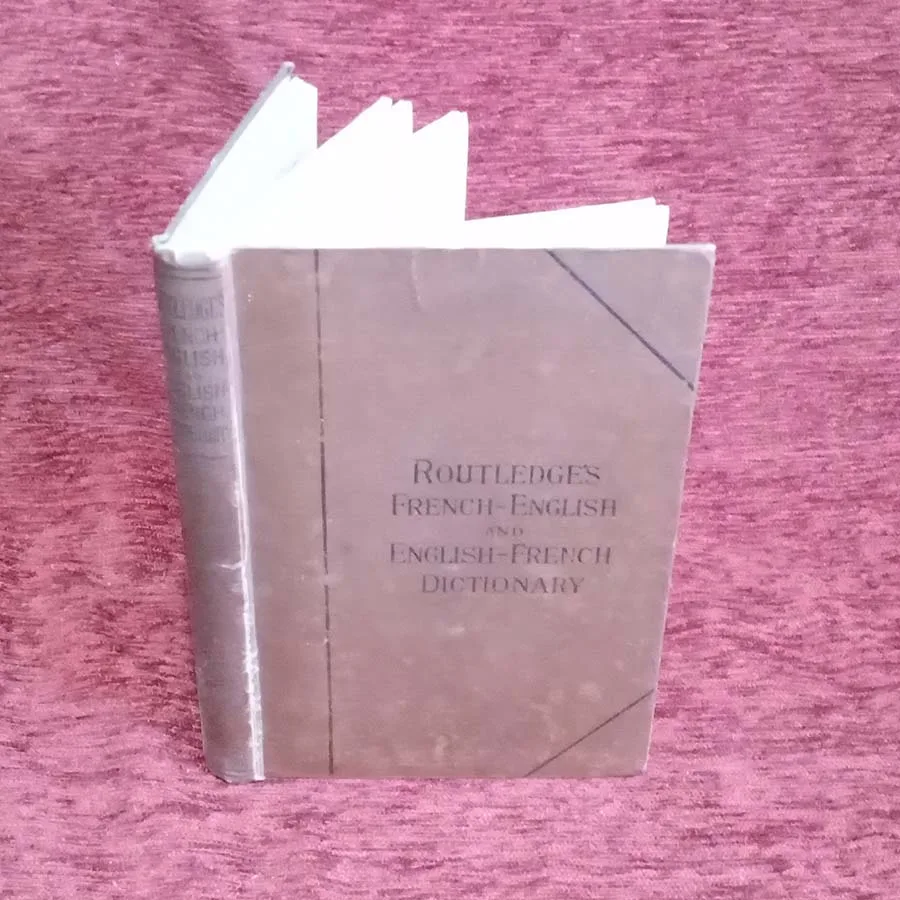
Publisher: George Routledge and Sons
Format: Hardback
ISBN: none
Some books aim to entertain, others to enlighten, and a few quietly promise to rescue the reader from the embarrassing moment of accidentally ordering soup when one meant to ask for the railway station. Routledge’s French-English and English-French Dictionary belongs firmly to that third and highly respectable category. Compact, purposeful and entirely serious about the business of translation, it is the sort of book that once travelled everywhere with students, travellers and the occasionally optimistic self-improver.
Published by George Routledge and Sons and here appearing in the Twentieth Edition, this little volume comes from the golden age of practical educational publishing. Based on the publisher’s address and printer details, the book dates to roughly 1900–1910, with about 1905 being the most plausible moment of birth. That places it neatly in the late Victorian–Edwardian world when bilingual dictionaries were not decorative accessories but genuine intellectual tools, carried about with a certain quiet determination and opened whenever French grammar began behaving suspiciously.
There is something wonderfully direct about dictionaries of this era. The title wastes no time on marketing flair. It simply announces itself as a French-English and English-French Dictionary, which is exactly what it intends to be. Inside lies a compact universe of words, patiently arranged to help the reader cross that delicate bridge between languages without falling into the swamp of misunderstanding. It is an admirable ambition, and one that millions of schoolchildren, travellers and correspondence writers relied upon with varying degrees of success.
The Twentieth Edition status adds a pleasing sense of authority. By the time a dictionary reaches its twentieth outing, it has clearly proved itself useful enough to survive generations of linguistic confusion. One imagines earlier editions sitting on school desks, in clerks’ offices, beside travel trunks or in the coat pockets of earnest young men attempting to improve their French with heroic persistence. Dictionaries rarely achieve celebrity, but they often achieve something better: quiet reliability.
Physically, the book has the compact, sturdy charm typical of pocket reference works from the period. It was designed to be practical rather than luxurious, small enough to carry yet solid enough to withstand repeated consultation. The format suggests the sort of volume that might once have lived in a satchel, been pulled out in moments of urgent translation, then returned to a shelf once the immediate crisis of vocabulary had passed. It is exactly the sort of book that feels as though it has done honest work.
This copy remains in Good condition, which is impressive for a reference book more than a century old. Dictionaries tend to live hard lives: opened flat, thumbed through rapidly, consulted in panic, and occasionally blamed for the shortcomings of the user. The survival of this one in such respectable form adds to its appeal. It carries just enough age to remind the reader of its long service, without losing the quiet dignity of its original purpose.
There is also something gently ironic about old bilingual dictionaries. They present language as though it were a tidy system of equivalents, neatly arranged across two columns, calmly implying that every word has a dependable partner waiting in another tongue. Anyone who has ever wrestled with French idiom will know that reality can be considerably more mischievous. Yet that optimistic structure is precisely what gives these dictionaries their charm: a brave attempt to organise the unruly behaviour of language into something manageable.
For modern collectors and readers, the book offers several pleasures at once. It is a handsome Edwardian reference volume, a small piece of the history of language learning, and an evocative reminder of a time when dictionaries were essential companions rather than background tools hidden in digital devices. The physicality of it — cloth binding, compact format, clear typography — has a reassuring solidity that modern reference material rarely manages.
As a Crappy Old Books item, it fits beautifully into the category of objects that were once entirely practical and have now become quietly charming historical artefacts. A small dictionary like this speaks of classrooms, correspondence, travel ambitions and the steady belief that education was something one carried in the pocket as well as in the mind.
In short, this Routledge’s French-English and English-French Dictionary, dating from roughly 1900–1910 and most likely around 1905, is a delightful survivor from the age of serious linguistic self-improvement. In Good condition and proudly bearing its Twentieth Edition, it remains a compact and characterful Crappy Old Books volume — a small Edwardian bridge between two languages, patiently waiting for someone to open it and ask, once again, what on earth that word means.
Keep browsing: See more French books Other books by Routledge
